Open-source graph database, retrieval, simulation, and visualization platform for connectome-scale neuroscience.
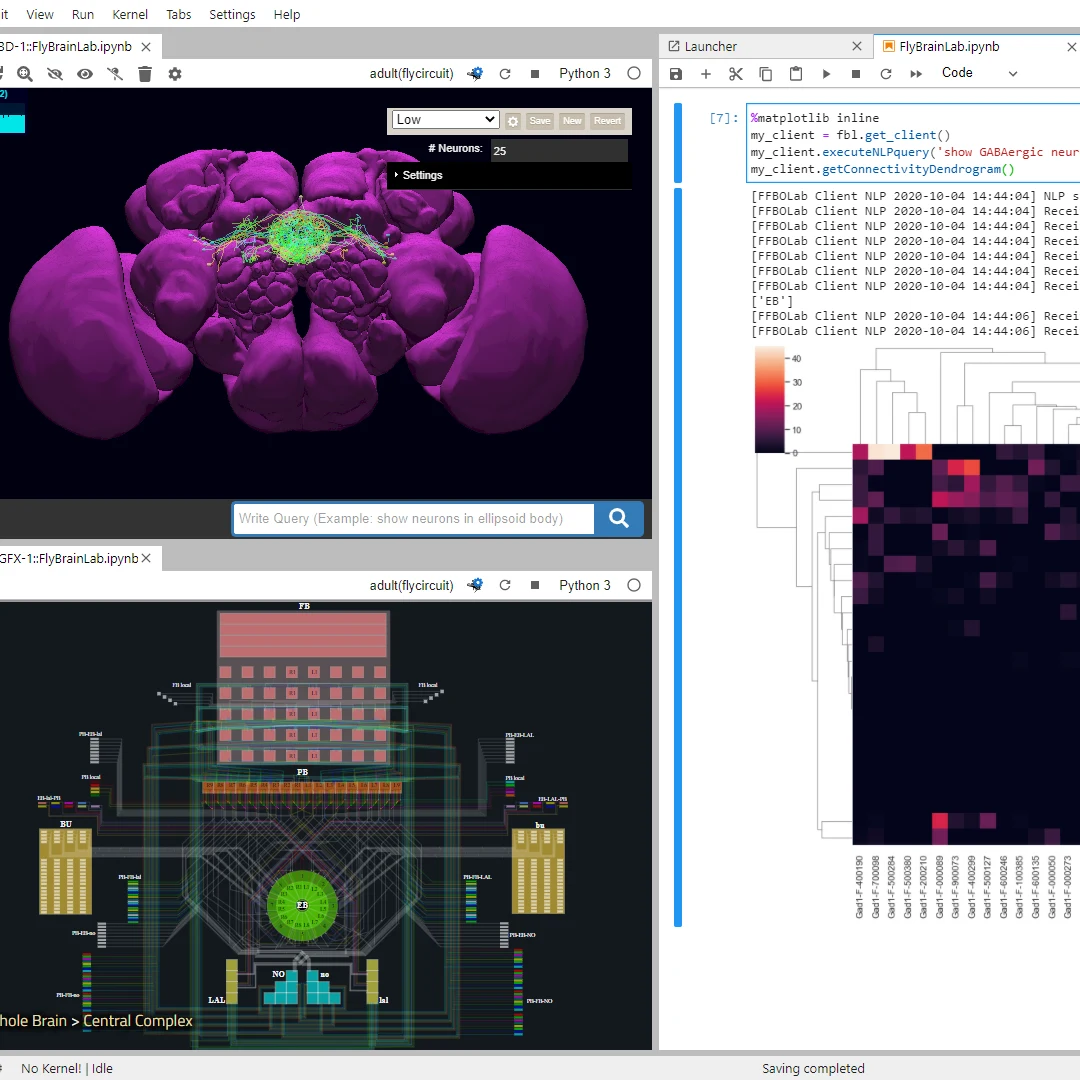
FlyBrainLab is an open-source platform for exploring, querying, visualizing, and simulating fruit fly brain circuits at connectome and synaptome scale.
The eLife and Frontiers contribution statements document my role in co-conceiving FlyBrainLab’s architecture and developing the platform, user-side and utility libraries, validation workflows, visualizations, comparative circuit models, NeuroNLP++, and the FeedbackCircuits library.
FlyBrainLab can be understood as an early incarnation of the research-oriented AI workbenches now emerging around LLMs. Its NeuroNLP++ interface accepted free-form scientific questions and coordinated access to published research, programmable ontologies, and structured connectome data, then connected the results to executable graph queries, GPU-backed simulations, and interactive 3D visualizations. This system shape closely resembles tools such as Claude Science, with a natural language interface spanning literature, domain databases, computation, and scientific artifacts. FlyBrainLab predated modern general-purpose LLMs, so its language layer instead combined ontology-backed knowledge bases, literature-linked entity retrieval, dense passage retrieval, and biomedical BERT question answering. Building it gave me direct experience with many of the same grounding, retrieval, tool integration, and provenance problems that define current agentic research systems.
The platform combined a TypeScript/JupyterLab front end, an OrientDB-backed NeuroArch graph database, RPC APIs, and large-scale connectome and synaptome querying with the simulation and visualization stack.
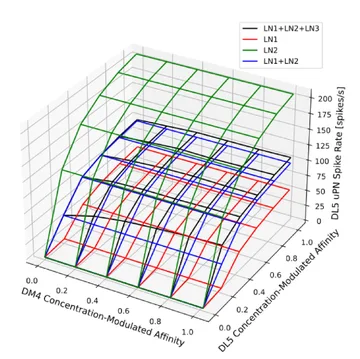
The Drosophila brain has only a fraction of the number of neurons of higher organisms such as mice and humans. Yet the sheer complexity of its neural circuits recently revealed by large connectomics datasets suggests that computationally modeling the function of fruit fly brain circuits at this scale poses significant challenges. To address these challenges, we present here a programmable ontology that expands the scope of the current Drosophila brain anatomy ontologies to encompass the functional logic of the fly brain. The programmable ontology provides a language not only for modeling circuit motifs but also for programmatically exploring their functional logic. To achieve this goal, we tightly integrated the programmable ontology with the workflow of the interactive FlyBrainLab computing platform. As part of the programmable ontology, we developed NeuroNLP++, a web application that supports free-form English queries for constructing functional brain circuits fully anchored on the available connectome/synaptome datasets, and the published worldwide literature. In addition, we present a methodology for including a model of the space of odorants into the programmable ontology, and for modeling olfactory sensory circuits of the antenna of the fruit fly brain that detect odorant sources. Furthermore, we describe a methodology for modeling the functional logic of the antennal lobe circuit consisting of a massive number of local feedback loops, a characteristic feature observed across Drosophila brain regions. Finally, using a circuit library, we demonstrate the power of our methodology for interactively exploring the functional logic of the massive number of feedback loops in the antennal lobe.
2021
Accelerating with FlyBrainLab the discovery of the functional logic of the Drosophila brain in the connectomic and synaptomic era
Mehmet Kerem Turkcan, Aurel A. Lazar, Tingkai Liu, and Yiyin Zhou
In recent years, a wealth of Drosophila neuroscience data have become available including cell type and connectome/synaptome datasets for both the larva and adult fly. To facilitate integration across data modalities and to accelerate the understanding of the functional logic of the fruit fly brain, we have developed FlyBrainLab, a unique open-source computing platform that integrates 3D exploration and visualization of diverse datasets with interactive exploration of the functional logic of modeled executable brain circuits. FlyBrainLab’s User Interface, Utilities Libraries and Circuit Libraries bring together neuroanatomical, neurogenetic and electrophysiological datasets with computational models of different researchers for validation and comparison within the same platform. Seeking to transcend the limitations of the connectome/synaptome, FlyBrainLab also provides libraries for molecular transduction arising in sensory coding in vision/olfaction. Together with sensory neuron activity data, these libraries serve as entry points for the exploration, analysis, comparison, and evaluation of circuit functions of the fruit fly brain.